
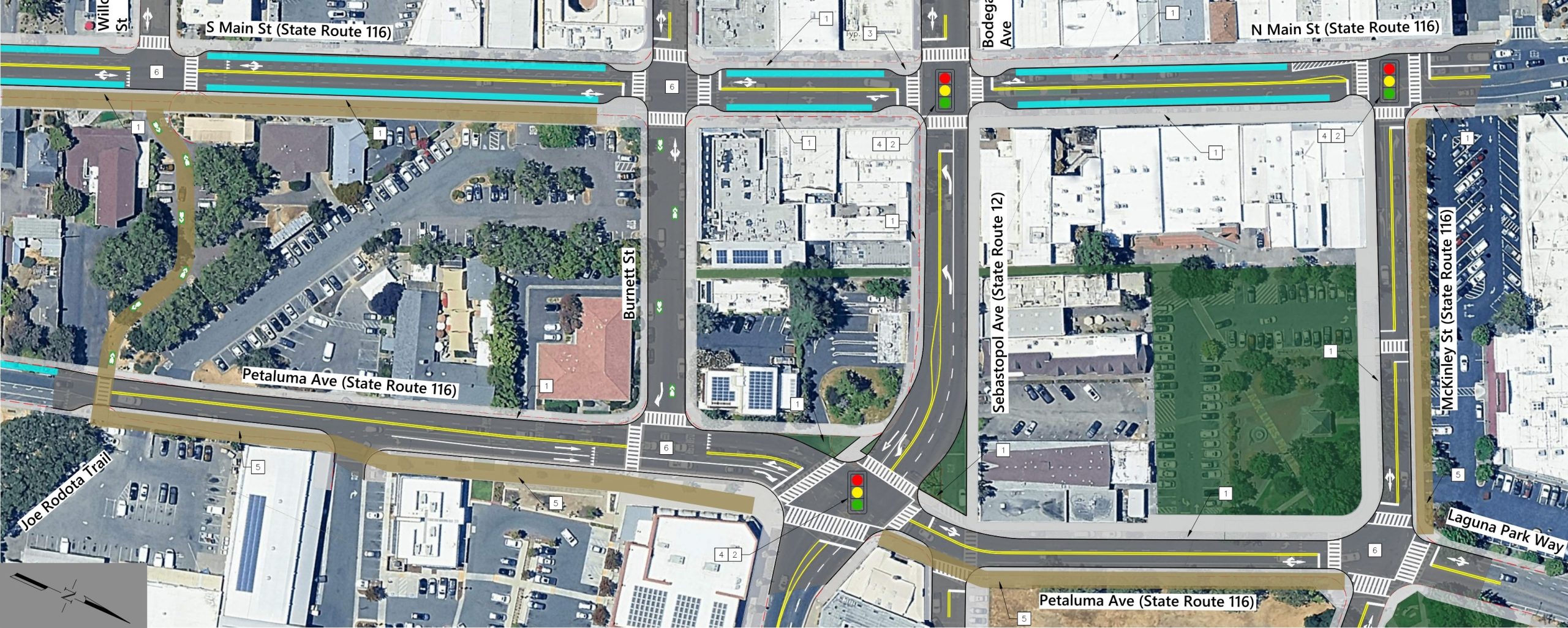
Sebastopol was awareded a Sustainable Transportation Grant from Caltrans a couple of years ago. The consultant team has been working on the grant for the past couple of years meeting with stakeholders, public workshops and in public meetings with the planning commission and city council. At the city council meeting two weeks ago the project manager from Fehr & Peers presented the final report for adoption by the council. The council adopted the final report on a 4-1 vote. There was surprisingly little opposition at the council meeting. A couple people spoke about concerns about traffic congestion, but there was certainly not the extent of public comment that there had been at the planning commission and council meetings to review the draft plan.
The final plan is interesting and I think does take into account a lot of the public comment provided throughout the process and adapts it to Sebastopol’s unique downtown environment. Some of the priorities brought up during the public process include:
- the importance of downtown’s local businesses and small town character
- a strong desire for safer crossings and slower vehicle speeds
- interest in wider sidewalks, greenery and spaces to gather
- ongoing concerns about congestion, parking and business access
The final report points out ‘the tension between regional mobility and local needs…Streets are designed to move vehicles efficiently, but this comes at the expense of comfort and safety for people walking and bicycling.’ The downtown ‘functions more like a highway corridor than a traditional main street.’ The report also states ‘existing conditions reflect a system that prioritizes vehicle movement but does not fully support the broader goals of safety, accessibility and downtown vitality.’
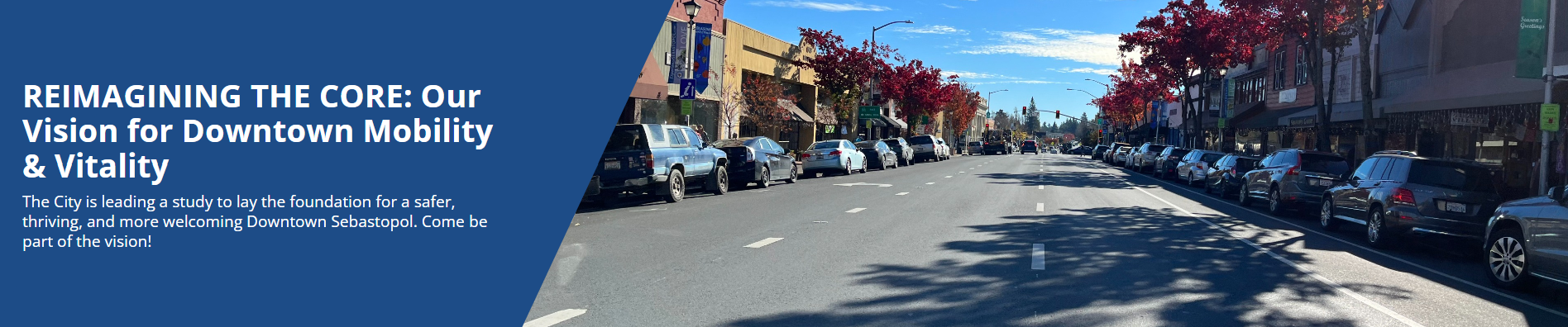
A summary of roadway design research is also provided along with more detail in an appendix. Highlights of the research include the fact the vehicle speed is a primary determinant of crash severity, and that street design is more influential in ultimate vehicle speeds than simply a posted speed limit sign along with enforcement. Which basically means that drivers drive as fast as they feel comfortable driving on the roadway. Sebastopol’s existing one-way couplet system and wider than necessary lanes encourages faster driving than is comfortable for pedestrians and cyclists. The research summarized in the report also notes that downtown main streets ‘should be designed to support a mix of users and activities, rather than prioritizing through traffic.’ Even Caltrans acknowledges this in their Design Information Bulletin 94 Complete Streets: Contextual Design Guidance. The following table is from the Caltrans DIB 94:
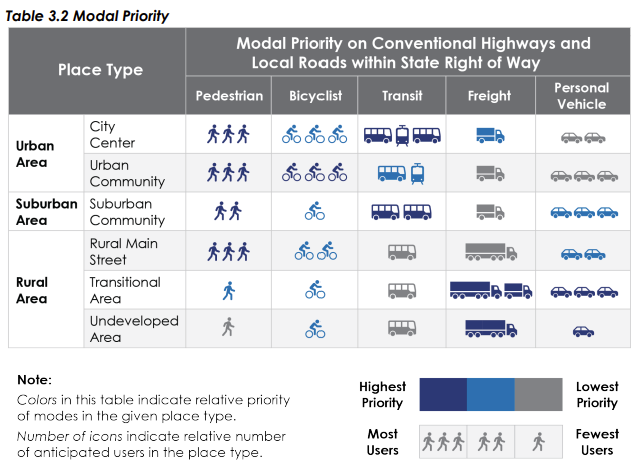
According to this Caltrans guidance, rural main streets should give priority to pedestrians. That is clearly not the case in the current design of downtown Sebastopol.
The report does also address the possibility of a bypass around Sebastopol. The concept of a bypass around the city has been around for many decades and is often brought up as a way to reduce the amount of through traffic along SR 116, the north-south corridor through Sebastopol which includes Main Street. The report notes that any possible alignment ‘would face substantial constraints, including environmental impacts to sensitive habitats and agricultural lands, as well as right-of-way acquisition challenges and potential community impacts.’ Fehr & Peers also used regional travel demand modeling to evaluate the potential effectiveness of a bypass. This modeling indicated a bypass would have minimal impact on overall regional travel patterns and therefore not be of much benefit to vehicle congestion in downtown Sebastopol. The report notes the bypass is not feasible at this time, nor likely any other since it has never come to pass in the decades since it was first brought up.
The consultants also used traffic modeling to evaluate a variety of circulation scenarios. They measured both vehicle miles traveled (VMT) and vehicle hours traveled (VHT). None of the scenarios tested eliminated congestion in downtown Sebastopol, but the two way circulation did improve access and reduce travel distances.
The schematic plan addresses ‘three core objectives: improving safety and comfort for people walking, supporting local businesses and downtown vitality, and maintaining functional access and circulation for all users.’ The plan restores the two-way vehicle network on all downtown streets, reallocates right-of-way from vehicles to pedestrians and cyclists and includes enhancements to the pedestrian and bike environment.
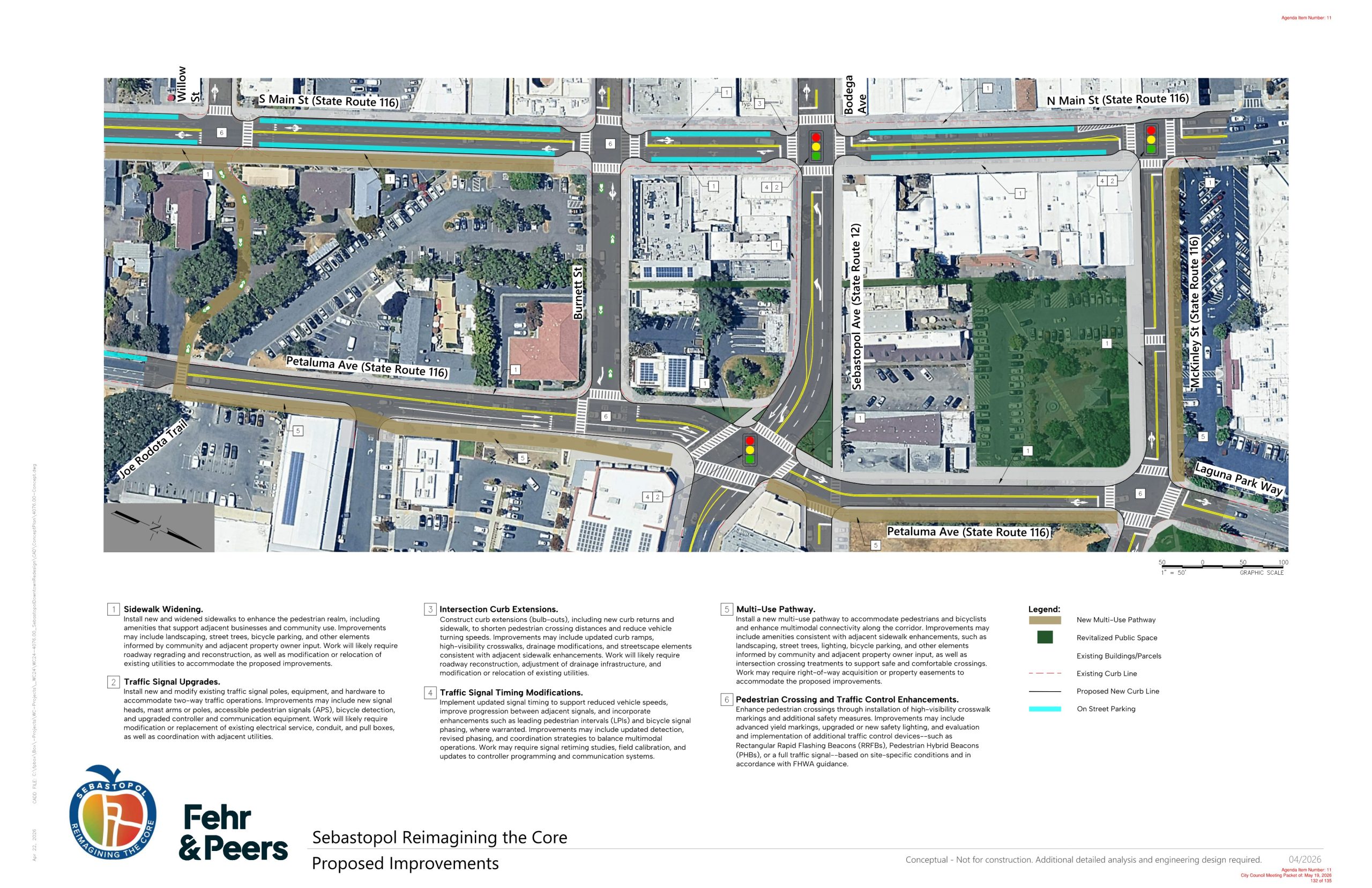 One of the defining elements of the plan is a multi-use pathway. This would extend from the south side of downtown back to the Main Street/Petaluma Avenue split. There is an additional multi-use pathway that will extend from the Joe Rodota Trail intersection with Petaluma Avenue south of downtown heading north alongside Petaluma Avenue and then west on McKinley Avenue to connect again with Main Street. The shared pathway also connects the Joe Rodota Trail to Main Street, near the post office. This would be a wide (20′) shared pathway with bikes/wheeled things on one side and pedestrians on the other. This will be a great and unique feature to have in our downtown that will encourage people to get out of their cars on their trips downtown.
The highlights of the plan also includes curb extensions at downtown intersections for safer/shorter pedestrian crossings, additional sidewalk widening downtown between McKinley and Burnett (17′ wide), streetscape enhancements (lighting, landscaping, street furniture) and parallel parking on both sides of Main Street. The 17′ wide sidewalks will be able to accommodate trees and landscaping, bicycle parking and outdoor seating. Some cycling advocates are not pleased that neither the multi-use path nor a bike lane extend the length of Main Street through the core of downtown. Bike that are continuing through downtown will be routed around the 2 core blocks of Main Street. Ideally, I think it would be great to continue bike access through Main Street, but it was a trade-off with wider sidewalks and street parking. I think it was the appropriate call at this time. With adequate safe and secure bike parking at key locations at the north and south of downtown I think this plan can work for cyclists with destinations downtown. When you come to downtown in a car, you shouldn’t expect to park directly in front of your destination. You should expect to have to walk some distance from where you park. The same approach should work for cyclists as well. Park your bike at the edge of downtown and walk the final block or two to your destination.
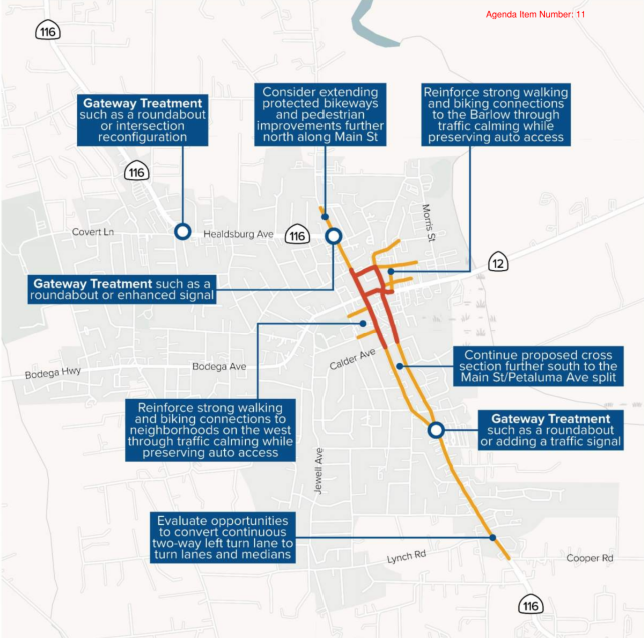
There is a lot of work to be done to bring this plan to fruition and the report discusses that process as well. This includes grant opportunities which will be critical to secure as well as how to potentially phase the work. They also note that there are a number of improvements that will need to be made outside the downtown core to support the plan.
Of course not everyone is happy about the plan. But the final plan was never going to make everyone happy. That’s not a realistic expection. Much of the opposition revolved around the fear of increased traffic congestion. I just don’t think this is something we need to be fearful of. And in some ways, it is something we should embrace. Many of our most beloved places also have congestion. Because they are beloved places and people want to be there. So congestion that is a result of our success of transforming our downtown is welcome. Cars that are moving slowly due to congestion are also much safer to be around. I feel much safer riding my bike when I am able to peddle faster than the cars in the adjacent lane. When the cars are moving 20 mph faster than me, that doesn’t feel so great. I feel that when we are able to implement this plan some of the current opponents will come around. And some will not. And that is OK.
I’m really grateful that the city was able to secure this grant and I feel that this plan is a good outcome of all the effort. I excited to get into the implementation phase and start making this plan become a reality.
Thanks for all your work on this!